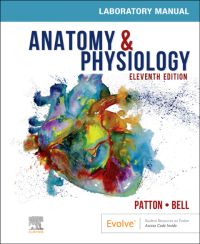
Anatomy & Physiology Laboratory Manual and E-Labs E-Book, 11th Edition
Gain the hands-on practice needed to understand anatomical structure and function! Anatomy & Physiology Laboratory Manual and eLabs, 11th Edition provides a clear, step-by-step guide to dissection, anatomy identification, and laboratory procedures. The illustrated, print manual contains 55 A&P exercises to be completed in the lab, with guidance including instructions, safety tips, and tear-out worksheets. Online, eight eLab modules enhance your skills with simulated lab experiences in an interactive 3-D environment. From noted educators Kevin Patton and Frank Bell, this laboratory manual provides you with a better understanding of the human body and how it works.
New to this edition
- NEW! More photos of various types of bones help you learn skeletal anatomy.
- NEW! More microscope slide images, including "zooming in" at high-power magnification, help you learn microscopic anatomy
- NEW! Updated lab tests align with what is currently in use in today’s lab environment
- NEW! Thorough revision of all chapters covers the latest anatomy and physiology lab exercises
Key Features
- Labeling exercises and coloring exercises make it easier to identify and remember critical structures examined in the lab and in lectures
- Step-by-step "check-box" dissection instructions with accompanying illustrations and photos cover anatomical models and fresh or preserved specimens — and provide helpful guidance during dissection labs
- Tear-out Lab Reports contain checklists, drawing exercises, and questions that help demonstrate your understanding of the labs you have participated in, and also allow instructors to check your progress
- 250 illustrations include photos of cat, pig, and mink dissections, photos of various bones, microscopic and common histology slides, and depictions of proper procedures
- Complete lists of materials for each exercise provide handy checklists for planning and setting up laboratory activities, allowing for easy and efficient preparation
- Modern anatomical imaging techniques, such as computed tomography (CT), magnetic resonance imaging (MRI), and ultrasonography, are introduced to demonstrate how new technologies are changing and shaping health care
- Review questions throughout the manual provide tools to reinforce and apply your knowledge of anatomy and function concepts
- Eight eLabs improve the laboratory experience in an interactive digital environment.
- Convenient spiral binding allows for hands-free viewing in the lab setting
- Hint boxes provide special tips on handling specimens, using equipment, and managing lab activities
- Learning objectives at the beginning of each exercise offer a clear framework for learning
Author Information
| ISBN Number | 9780323793568 |
|---|---|
| Main Author | By Kevin T. Patton, PhD and Frank B. Bell, DC, MSHAPI |
| Copyright Year | 2023 |
| Edition Number | 11 |
| Format | eBook |
| Imprint | Elsevier |
| Page Count | 0 |
| Publication Date | 15 Apr 2022 |
| Stock Status | IN STOCK |


eBooks : Built for busy schedules & tailored for your goals.


Affordable knowledge, built for you
Get the resources you need-often at a lower cost than print. Quality content designed to support your goals, without stretching your budget.


Seamless access wherever you are


Always in sync


Tools the make learning stick
Your eBook is ready whenever you are!
1. Check your email for your access code.


2. Sign into or create your VitalSource account and redeem your code.


3. Open your eBook - ready whenever you are!
FAQ
The access code for your new eBook will be sent in your order confirmation email. Your code can also be accessed in your My Account section on the Elsevier webshop. If you do not receive your code within a few minutes, please check your spam folder.
Step-by-step guidance on how to download Bookshelf and also redeem your code can be found here.
The access code for your new eBook does not expire. However, we always suggest redeeming immediately after purchase to start experiencing the benefits of and insights from your purchase. Important to note - the code provided is a single use code and only valid for the edition you purchase. It does not provide access to past nor future editions of the title.
You will have unlimited access to your eBook on the device to which it was downloaded.
Discover the various learning features that our eBooks offer on the Bookshelf® Reader! For example, you can highlight different text passages, create notes and flashcards, have the text read to you, etc. Particularly practical: You can also use your eBooks offline. More information on the learning functions can be found on the Vitalsource page.
Quality is our top priority. That's why we collaborate with the leading eBook reader provider VitalSource. VitalSource has its own eBook reader Bookshelf®, which you can easily download. This reader is very user-friendly and offers more features than other standard readers. For example, you can highlight different text passages, create notes and flashcards, have the text read to you, etc. Particularly practical: You can also use your eBooks offline. More information can be found on the Vitalsource page.
Elsevier offers its eBooks in ePub format, as we believe this format is best suited to display our content ideally on as many devices as possible.
You can return your eBook within 13 days of purchase. eBooks that have been partially printed or flipped through more than 15% are excluded from returns.
Any questions ?
Top Picks from Our Community
eBook
eBook
Marie T. O'Toole
Jun 2026
eBook
Robert J. Hubert
Jun 2026
eBook
Edited by Sara C. McIntire
Jun 2026
eBook
Ronald M. Harden
May 2026
eBook
Edited by Cynthia A. Wong
Dec 2025
eBook
Edited by Sebastian G. de la Fuente
May 2026
eBook
Carl M. Allen
May 2026
eBook
Edited by Gonzalo Bastias
May 2026
eBook
eBook
Debbie S. Robinson
May 2026
eBook
Dennis M. Ruscello
Dec 2009
eBook
Carol J. Buck
Aug 2013
eBook
eBook
eBook
eBook
eBook
Carol J. Buck
Oct 2011
eBook
Davi-Ellen Chabner
Feb 2013
eBook
Carol J. Buck
Dec 2012
eBook
Carol J. Buck
Aug 2012
eBook
Carol J. Buck
Oct 2011
eBook
Carol J. Buck
Aug 2012
eBook
Carol J. Buck
Aug 2013
eBook
Carol J. Buck
Dec 2013
WELCOME TO THE ANATOMY AND PHYSIOLOGY LABORATORY
The Scientific Method
Measurement and Data Collection
How to Dissect
Using this Manual
Safety First!
How to Study for Lab Quizzes
THE BASICS
1. Organization of the body
2. Dissection: The whole body
3. The Microscope
4. Cell Anatomy
5. Transport through Cell Membranes
6. The Cell's Life Cycle
7. Epithelial Tissue
8. Connective Tissue
9. Muscle and Nerve Tissue
SUPPORT AND MOVEMENT
10. The Skin
11. Overview of the Skeleton
12. The Skull
13. The Vertebral Column and Thoracic Cage
14. The Upper Extremities
15. The Lower Extremities
16. Joints
17. Organization of the Muscular System
18. Skeletal Muscle Identification
19. Dissection: Skeletal Muscles
20. Skeletal Muscle Contractions
INTEGRATION AND CONTROL
21. Nerve Tissue
22. Nerve Reflexes
23. The Spinal Cord and Spinal Nerves
24. The Brain and Cranial Nerves
25. The Dissection: The Brain
26. Somatic Senses
27. Senses of Taste and Smell
28. The Ear
29. Hearing and Equilibrium
30. The Eye
31. Visual Function
32. Endocrine Glands
33. Hormones
REGULATION AND MAINTENANCE
34. Blood
35. Structure of the Heart
36. Electrical Activity of the Heart
37. The Pulse and Blood Pressure
38. The Circulatory Pathway
39. The Lymphatic System
40. Dissection: Cardiovascular and Lymphatic Systems
41. Respiratory Structures
42. Dissection: Respiratory System
43. Pulmonary Volumes and Capacities
44. Digestive Structures
45. Dissection: Digestive System
46. Enzymes and Digestion
47. Urinary Structures
48. Dissection: Urinary System
49. Urinalysis
REPRODUCTION
50. The Male Reproductive System
51. The Female Reproductive System
52. Dissection: Reproductive Systems
53. Development
54. Genetics and Heredity
SYNTHESIS
55. The Whole Body
LAB REPORT SUPPLEMENT