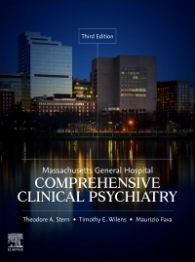
The Massachusetts General Hospital is widely regarded as one of the world's premier psychiatric institutions. Massachusetts General Hospital Comprehensive Clinical Psychiatry, 3rd Edition, offers practical, informative, and hands-on advice from the staff of the esteemed MGH Department of Psychiatry, helping you put today’s best practices to work for your patients. This authoritative reference covers a wide variety of clinical syndromes and settings, aided by superb graphics throughout. In one convenient volume, you’ll have easy access to the answers you need to face and overcome any clinical challenge.
Key Features
- Uses a reader-friendly and highly templated format with abundant boxed summaries, bulleted points, case histories, algorithms, references, and suggested readings.
- Contains new chapters on the Psychiatric Management of Patients with Cardiac, Renal, Pulmonary, and Gastrointestinal Disease; COVID-19 Infection; Burns, Trauma, and Intensive Care Unit Treatment; Care of LGBTQ Patients; and Mindfulness and Resilience.
- Covers key areas, such as Substance Use Disorders; Mood, Anxiety, and Psychotic Disorders; Emergency Psychiatry; Functional Neuroanatomy and the Neurologic Examination; Psychological and Neuropsychological Assessment; Military Psychiatry; Psychiatric Manifestations of Traumatic Brain Injury; Legal and Ethical Issues in Psychiatry; End of Life Care; and Approaches to Collaborative Care and Primary Care Psychiatry.
- Features key points for every chapter, updated DSM-5 criteria, and enhanced content on collaborative care and behavioral medicine, ensuring that your knowledge is thorough and up to date.
- Corresponds to the companion review volume, Massachusetts General Hospital Study Guide for Psychiatry Exams, 2nd Edition (ISBN: 978-0-443-11983-5).
- Any additional digital ancillary content may publish up to 6 weeks following the publication date.
Author Information
Edited by Theodore A. Stern, MD, Psychiatrist and Chief Emeritus, Avery D. Weisman Psychiatry Consultation Service, Director, Thomas P. Hackett Center for Scholarship in Psychosomatic Medicine, Massachusetts General Hospital, Boston, MA, USA, Ned H. Cassem Professor of Psychiatry in the Field, Psychosomatic Medicine/Consultation, Harvard Medical School, Boston, MA, USA; Timothy E. Wilens, MD, Chief of the Division of Child and Adolescent Psychiatry and Co-director of the Center for Addiction Medicine; Massachusetts General Hospital (MGH); MGH Trustees Chair in Addiction Medicine and Professor of Psychiatry, Harvard Medical School and Maurizio Fava, MD, Psychiatrist-in-Chief, Department of Psychiatry, Vice Chair, Executive Committee on Research, Massachusetts General Hospital, Boston, MA, USA, Executive Director, Clinical Trials Network & Institute (CTNI), Massachusetts General Hospital, Boston, MA, USA, Associate Dean for Clinical & Translational Research & Slater Family Professor of Psychiatry, Harvard Medical School, Boston, MA, USA
PART I Approach to the Patient
1. The Doctor–Patient Relationship
2. The Psychiatric Interview
3. Laboratory Tests and Diagnostic Procedures
4. Treatment Adherence
PART II Human Development
5. Child, Adolescent, and Adult Development
PART III Rating Scales and Psychological/Neuropsychological Testing
6. Diagnostic Rating Scales and Psychiatric Instruments
7. Understanding and Applying Psychological Assessment
8. Neuropsychological Assessment
PART IV The Psychotherapies
9. Coping with Medical Illness and Psychotherapy of the Medically Ill Patients
10. An Overview of the Psychotherapies
11. Brief Psychotherapy: An Overview
12. Couples Therapy
13. Family Therapy
14. Group Psychotherapy
15. Cognitive-Behavioral Therapy, Behavioral Therapy, and Cognitive Therapy
PART V Disorders of Cognition
16. Delirium
17. Neurocognitive Disorders and Dementia
18. Intellectual Disability
PART VI Psychiatric Diagnoses and Conditions
19. The DSM-5 and DSM-5 Text Revision: A System for Psychiatric Diagnosis
20. Psychiatric Neuroscience: Incorporating Pathophysiology into Clinical Case Formulation
21. Mental Disorders Due to Another Medical Condition
22. Sleep Disorders
23. Disruptive, Impulse, Control, and Conduct Disorders
24. Somatic Symptom Disorders
25. Factitious Disorders and Malingering
26. Substance Use Disorders
27. Psychosis and Schizophrenia
28. Depressive Disorders
29. Bipolar Disorder
30. Psychiatric Illness During Pregnancy and the Post-partum Period
31. Anxiety Disorders and Post-traumatic Stress Disorder
32. Obsessive-Compulsive and Related Disorders
33. Dissociative Disorders
34. Sexual Disorders and Sexual Dysfunction
35. Eating Disorders: Evaluation and Management
36. Grief, Bereavement, and Adjustment Disorders
37. Personality and Personality Disorders
38. Catatonia, Neuroleptic Malignant Syndrome, and Serotonin Syndrome
39. Child and Adolescent Psychiatric Disorders
PART VII Psychosomatic Medicine
40. Psychiatric Management of Patients with Cardiac Disease
41. Psychiatric Management of Patients with Renal Disease
42. Psychiatric Management of Patients with Gastrointestinal Disease
43. Pre-transplant Assessment and Post-transplant Management
44. HIV Infection and AIDS
45. COVID-19 Infection
46. Psychiatric Co-morbidities and Complications of Cancer and Cancer Treatment
47. Psychiatric Care of Patients with Pulmonary Disease
48. Burns, Trauma, and Intensive Care Unit Treatment
PART VIII Treatment Approaches
49. The Pharmacotherapy of Anxiety Disorders
50. Antipsychotic Drugs
51. Pharmacological Approaches to Depression and Treatment-Resistant Depression
52. Device Neuromodulation and Brain Stimulation Therapies
53. Lithium and Its Role in Psychiatry
54. The Use of Antiepileptic Drugs in Psychiatry
55. Pharmacotherapy of Attention-Deficit Hyperactivity Disorder Across the Life Span
56. Drug-Drug Interactions in Psychopharmacology
57. Side Effects of Psychotropic Medications
58. Natural Medications in Psychiatry
PART IX Special Topics in Psychiatry
59. The Suicidal Patient
60. Law and Psychiatry
61. Intimate Partner Violence
62. Psychiatric Correlates and Consequences of Abuse and Neglect
63. Patients with Genetic Syndromes
64. Serious Mental Illness
65. Community Psychiatry
66. Culture and Psychiatry
67. Psychiatric Epidemiology
68. Collaborative Care and Primary Care Psychiatry
69. Geriatric Psychiatry
70. Care at the End of Life: Psychiatric and Ethical Aspects
71. Care of LGBTQIA+ Patients
72. Obesity and Its Management
PART X Neuropsychiatry
73. Neuroanatomical Systems Relevant to Neuropsychiatric Disorders
74. The Neurological Examination
75. Neuropsychiatric Principles and Differential Diagnosis
76. Neuroimaging in Psychiatry
77. Clinical Neurophysiology and Electroencephalography
78. Epilepsy and Its Psychiatric Manifestations
79. Differential Diagnosis and Treatment of Headaches
80. Pathophysiology, Psychiatric Co-morbidity, and Treatment of Pain
81. Psychiatric Aspects of Stroke Syndromes
82. Psychiatric Manifestations of Traumatic Brain Disorder
PART XI Care in Special Settings
83. Emergency in Psychiatry
84. Military Psychiatry
85. Disaster Psychiatry
86. Global Psychiatry and Mental Health in the Post-pandemic world
87. The Interface of Climate and Psychiatry
88. Sport Psychiatry
89. School Collaboration and Consultation
PART XII Preparing for the Future
90. Coping with the Rigors of Psychiatric Practice
91. Mindfulness and Resilience
Index
"This third edition book is a broad introductory textbook, with accompanying eBook resources. It gives an overview of the fundamentals critical for mastery for psychiatric residents. From foundational topics of patient interaction and common diagnoses to the implications of unique populations and treatment settings, the book provides an excellent guide for mastery of the psychiatric clinical fundamentals. This new edition justifies replacing the last one, published in 2015." ©Doody’s Review Service, 2024, Daniel M Tuinstra, MD (Holland Hospital), Doody’s Score: 97 - 5 Stars!