

Underwood's Pathology: a Clinical Approach - E-BOOK, 8th Edition
A thorough understanding of pathology is crucial for doctors and a foundation for safe and effective clinical practice. This internationally renowned, award-winning textbook provides a comprehensive overview, aligned to the needs of current medical students and early career stage doctors.
The book starts with a clear introduction to the basic principles of pathology, then moves on to more detailed discussion of disease mechanisms and the pathology of specific disorders ordered by body system. The text has been fully updated for this eighth edition and optimized for efficient study.
Complete with unrivalled photographs, images, graphics and supplementary electronic materials, Underwood’s Pathology is the complete learning package no medical student should be without.
The book starts with a clear introduction to the basic principles of pathology, then moves on to more detailed discussion of disease mechanisms and the pathology of specific disorders ordered by body system. The text has been fully updated for this eighth edition and optimized for efficient study.
Complete with unrivalled photographs, images, graphics and supplementary electronic materials, Underwood’s Pathology is the complete learning package no medical student should be without.
ISBN :
9780443117428
Publication Date :
25-06-2024
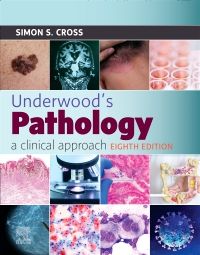
A thorough understanding of pathology is crucial for doctors and a foundation for safe and effective clinical practice. This internationally renowned, award-winning textbook provides a comprehensive overview, aligned to the needs of current medical students and early career stage doctors.
The book starts with a clear introduction to the basic principles of pathology, then moves on to more detailed discussion of disease mechanisms and the pathology of specific disorders ordered by body system. The text has been fully updated for this eighth edition and optimized for efficient study.
Complete with unrivalled photographs, images, graphics and supplementary electronic materials, Underwood’s Pathology is the complete learning package no medical student should be without.
The book starts with a clear introduction to the basic principles of pathology, then moves on to more detailed discussion of disease mechanisms and the pathology of specific disorders ordered by body system. The text has been fully updated for this eighth edition and optimized for efficient study.
Complete with unrivalled photographs, images, graphics and supplementary electronic materials, Underwood’s Pathology is the complete learning package no medical student should be without.
New to this edition
- Fully revised throughout
- New sections on the pathology of Covid-19 in all relevant sections
- Extensive revision of the molecular pathology of tumours
Key Features
- Comprehensive but concise and understandable for medical students - also suitable for junior doctors, early career pathologists/histopathologists, dental students and biomedical scientists
- Ideal for integrated, systems-based courses and problem-based learning – reflects modern medical curricula
- Structure makes content highly accessible – easy to look up any pathology seen in the classroom or on the wards
- Presents pathology in the context of modern cellular and molecular biology and contemporary clinical practice
- Unrivalled collection of nearly 700 clinical photographs, histopathology images and graphics
- Includes a full patient symptoms index plus multiple quick-reference summary tables
- Prepared by leading pathology experts and educators – for coverage you can trust
Author Information
Edited by Simon S. Cross, MD FRCPath, Professor of Diagnostic Histopathology and Honorary Consultant, Histopathologist, Academic Unit of Pathology, Department of Neuroscience, Faculty of Medicine, Dentistry & Health, The University of Sheffield, Beech Hill Road, Sheffield, UK
